
Hiring a Private Chef for a Dinner Party: A Host's Guide to the Evening
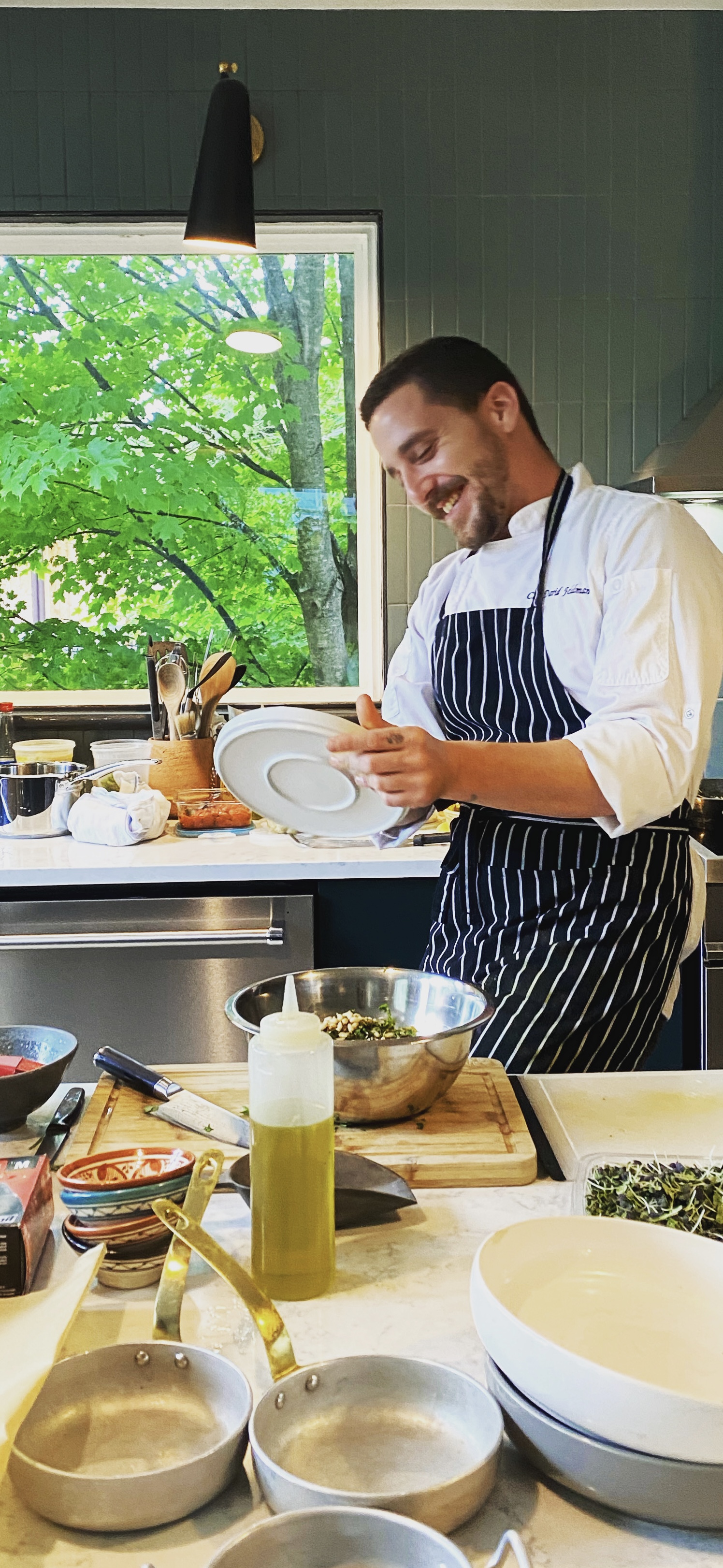
Everything a first-time host needs to decide, in the order it comes up, from the first inquiry to the last plate.

The candles are lit. The table you spent the afternoon setting is full, and the room has that particular sound a dinner party makes once everyone has stopped standing and started talking. In the kitchen, someone is finishing the charred eggplant carpaccio and slicing focaccia to go out with the salatim. The plates go out together. You're not carrying them. You're sitting at the head of your own table with a glass in your hand, and the only thing you have to decide is who to talk to next.
That is the evening people picture when they think about hiring a private chef. What they rarely picture is everything that makes it possible: what the chef needs from their kitchen, how the menu gets written, what happens in the hour before the doorbell rings, and what they're still responsible for as the host.
This guide covers all of it, in roughly the order you'll need to think about it. It's written for people in New York, New Jersey and Connecticut planning a dinner for ten adults or more who have hosted many evenings, just never with a chef in the kitchen.
When a private chef is the right call
A private chef makes the most sense at the point where cooking would take you away from your own party. For six people, most confident hosts can cook and still sit down. At ten, it gets hard: you're plating while the conversation goes on without you, and the dinner you meant to enjoy becomes a dinner you're running. That's why Chef David's private dinners start at ten adult guests.
The occasions vary. A birthday with the people who matter most. A holiday table you'd rather sit at than stand behind, since Chef David also cooks Shabbat and holiday dinners at home. A dinner for friends who haven't been in one room for years. What they share is that the table itself is the occasion.
There's an upper limit, too. Once you're planning a venue, a bar with its own staff, a dance floor or service across several rooms, you're no longer planning a dinner. You're planning an event, and that needs a catering operation behind it. More on that at the end.
What Chef David cooks, and how a menu comes together

Chef David grew up in Haifa, cooking beside his mother, Esther, in a house where every Friday meal was a gathering. Those tables are where his cooking comes from, and his menus are still written around who is coming before anything else. He went on to train in Tel Aviv's top kitchens and at Bishulim, and his cooking today pairs the bold flavours of Israeli and Middle Eastern food with classic French technique.
In practice, a menu might open with focaccia and salatim, fattoush and a sea bass crudo with lemon and jalapeño, move to harissa-crusted branzino with ras el hanout cauliflower or grilled baby lamb chops over mansaf rice, and end with pistachio cake and candied orange peel. That's a sample, not a set list. Chef David shops for what is best that week, and he writes each menu around the people coming to dinner, so the same request in March and in October can produce two different meals.
This is also why a private dinner isn't a restaurant meal moved to your home. The menu is a conversation. You tell him about your guests; he suggests a direction; you change anything until it feels right. And the team that plans your dinner is the one that cooks and serves it, so nothing gets lost between a sales call and the stove.
The five things to know before you inquire
You don't need a menu in mind. What Chef David needs is five facts, and each one changes something specific about the evening.
The date. It decides availability first, because weekends and holidays fill first. Then it decides the market: what's in season shapes the menu. If you have two possible dates, offer both.
How many guests. A range is fine. The number determines how many people cook and serve, how the courses are paced and, at the upper end, whether plated service is still the right choice.
The occasion. A fortieth birthday and a relaxed Sunday dinner need different evenings, even with the same twelve people. The occasion sets the pacing, the number of courses and whether there is a moment the meal should build towards.
The room. Where people will eat, whether there's somewhere to stand with a drink first, and whether the kitchen opens onto the dining space. Two sentences about your home tell us more than a long list of preferences.
Dietary needs. Allergies, vegetarians, a child who eats only plain pasta, relatives with different levels of kosher observance. Dishes can be gluten-free, dairy-free, vegetarian or vegan. Our menus are kosher-style, prepared with Glatt Beit Yosef meats. Mashgiach supervision can be arranged upon request. Guests with particular religious requirements should check them with their own rabbi before you book. Raised early, these shape the menu; raised late, they turn into substitutions, and a substitution is never as good as a dish designed for the person eating it.
Those five are exactly what the inquiry form asks for.
What your kitchen needs, and what it doesn't

Hosts worry about their kitchens more than anything else, and the real answer is that it depends on the dinner. Chef David's team brings professional cooking equipment as needed, so you aren't expected to own a restaurant's worth of pans. What a particular menu needs from your kitchen (burners, oven space, refrigeration, power) is worked out in planning, once the menu and guest count are clear. Mention anything unusual early: an induction cooktop, a small oven, a kitchen that's mid-renovation.
Beyond the appliances, what matters most is space and flow.
Counter, fridge and flow
At some point every main course will be plated at the same moment, so the most useful thing you can do is clear counter space: move the coffee machine, the fruit bowl and the stack of mail for one evening. Free up a shelf or two in the fridge as well, for ingredients that arrive cold.
Then think about how the kitchen relates to the room. In an open-plan apartment the kitchen becomes part of the evening, and guests drift over to watch. You may enjoy that, or you may prefer the work to stay out of sight. Either works; tell us which, because it changes how the team sets up and when the final touches happen.
Tableware, linens and rentals
Don't assume plates, glassware or linens come with the dinner. What's needed is coordinated event by event, based on your guest count, the menu and what you already own, so raise it in the first conversation. A household with plates and glasses for ten may not have them for eighteen, and a plated dinner of several courses uses more pieces than most people expect. Where the count falls short, rentals may be part of the plan, and they're one of the things that affect the final quote.
If there's a serving dish you love, the platter that has been at every family holiday, mention it.
Getting in the door
In New York this deserves its own line on the list. Tell us whether there's a doorman, whether deliveries have to use a service elevator and during which hours, and where a vehicle can stop to unload. Ten minutes of detail in advance saves a much longer wait on the night.
Plated or family-style?
This decision changes the feel of the evening more than any single dish, so make it deliberately.
Plated courses

Each guest is served their own plate, course by course. A plated dinner has rhythm: a pause, a new course arriving, a moment for someone to explain what's on it. It suits milestone dinners and evenings where the food is meant to be one of the subjects of conversation. Chef David's chef's table tasting menus take this furthest, with the story of each dish told at the table. Plated service needs room to move around the table, and for a large table it usually needs more hands.
Family-style

Large platters go down the middle and guests pass them to one another. This is how the food Chef David grew up with is meant to be eaten: salatim and warm bread to begin, then slow-cooked or grilled mains, then something sweet. Passing dishes loosens a table in a way plated courses never quite do, which makes it the better choice when half your guests are meeting for the first time.
Or both
Plenty of dinners combine the two, with shared plates to open and a plated main, or the reverse. A good way to decide is to ask yourself what you want the room to feel like at nine o'clock.
How the evening unfolds

The team arrives with everything, sets up in your kitchen and starts cooking while you get ready. When guests arrive, ideally there's something small to eat while they find a drink and each other; nobody should spend the first half hour hungry.
At the table, courses follow the room rather than the clock. If a toast runs long, the next course waits. If a conversation is going well, nobody interrupts it for the sake of a plate. That's one of the quiet advantages of dinner at home: there's no second seating waiting for your table, so the evening takes the time it takes.
Hosts sometimes worry that having a team in the house will feel intrusive. The service Chef David aims for is the opposite: attentive when a course arrives, unobtrusive the rest of the time. For a tasting menu, he may come to the table to talk through a dish; for a family-style dinner, the food mostly speaks for itself.
When the last plates have gone and coffee is poured, the team cleans down and leaves your kitchen spotless. When the door closes behind your last guest, the evening is over for you too.
Wine, water and the drinks question
Decide early who is handling drinks, because it affects the menu. Beverage service and a bartender can be arranged, but they aren't automatically part of the dinner, so settle how drinks will work in the planning conversation. If you're pouring your own wine, say what you're opening, and the food can be written to sit beside it. Either way, plan on more water and more ice than seems reasonable, and have something genuinely good for guests who aren't drinking.
Why two quotes for "dinner for twelve" can differ
We don't publish set prices, because no two dinners are built the same way. The things that move a quote are predictable, though, and knowing them makes any quote easier to read:
Guest count, for ingredients and, past a point, more people cooking and serving.
The menu: the number of courses, the ingredients chosen and how much finishing each plate needs.
Service style: plated service for a large table generally takes more staff than family-style.
Staffing: how many people are in your kitchen and dining room on the night.
Rentals: plates, glassware, linens or furniture beyond what you have.
Location and logistics: travel, building access and anything that complicates load-in.
When you compare options, compare what's included as well as the total: who shops, who serves, who cleans, and what you'll still need to provide. The fastest route to an accurate number is the five facts above. Share them, and the quote will reflect your actual dinner rather than a guess.
Booking, and the week before
Book as early as you can, since weekends and holidays fill first. If your date is soon, ask about short notice anyway.
In the final week, confirm the guest count and any new dietary needs, send the building details, clear the counters and a shelf in the fridge, set out any serving pieces you'd like used, and decide where the coats are going. Somebody always asks.
When your dinner is really an event
Some evenings outgrow a dinner: an engagement party for a hundred, a wedding, an outdoor celebration with live stations and a bar. They need a venue plan, a full service team and a kitchen operation built for scale. Chef David's cooking scales up through KEDMA, his catering and event company, which plans the kitchen, the service team and the timing for celebrations of that size.
Let's plan your dinner
If you have a date in mind, or even just a season, tell Chef David about the table you're imagining: who's coming, what you're celebrating, and the room you'll be gathering in. He'll take it from there with ideas, questions and a menu written for your guests.
Or call 916-633-9055 to talk it through.
Chef David Feldman cooks private chef dinners in NYC and across Brooklyn, Queens, Long Island, Westchester, Northern New Jersey and Connecticut, as well as in South Florida.


